
Fashion in the years following World War II is characterized by the resurgence of haute couture after the austerity of the war years.
Namespaces Article Talk. Suddenly, Last Summer , What is a 1950s sheath dress for women Contact us! Once again, brown was the choice for basic colors.
Square shoulders and short skirts were replaced by the soft femininity of Christian Dior ‘s ” New Look ” silhouette, with its sweeping longer skirts, fitted waist, and rounded shoulders, which in turn gave way to an unfitted, structural look in the later s.
Bythe Paris fashion houses had reopened, and once again Paris resumed its position as the arbiter of high fashion. The “orderly, rhythmic evolution of fashion change” [1] had been disrupted by the war, and a new direction was long overdue.
What is a 1950s sheath dress for women
The padded shoulder, tubular, boxy line, and short skirt that had been around since before the war and was identified with uniforms was gone.
Television joined fashion magazines and movies in disseminating clothing styles. During the early s, designers in the decolonised Third World sought to create an identity distinct from European fashion.
Urban professionals in Asia and the Middle East, for example, might wear Western style suits with indigenous headgear such as the Astrakhanfez or keffiyeh.
By , tight fitting drainpipe jeans became popular among American women. sheath cocktail dress with sleeves dresses near me Accessories were a big trend in , becoming more showy, with some designers even embedding jewels in the heels of shoes.
In Indiathe traditional Sherwani was adapted into the Nehru collar business suit[5] while women frequently wore sarees in the workplace. Meanwhile, the Red Chinese developed the unisex Mao Suit in green, blue and grey to promote socialist values of equality.
One result of the Post-World War II economic expansion was a flood of synthetic fabrics and easy-care processes. For the duration of WW2 the Du Pont company produced nylon exclusively for the war effort.
At the end of the demand for nylon stockings was so great that Nylon riots ensued at stores selling the products. Social changes went hand-in-hand with new economic realities, and one result was that many young people who would have become wage-earners early in their teens before the war now remained at home and dependent upon their parents through high school and beyond, establishing the notion of the teenage years as a separate stage of development.
In the United Kingdom, the Teddy boys of the post-war period created the “first truly independent fashions for young people”, [10] favouring an exaggerated version of the Edwardian -flavoured British fashion with skinny ties and narrow, tight trousers worn short enough to show off garish socks.
Previously, teenagers dressed similarly to their parents, but now a rebellious and different youth style was being developed. Young adults returning to college under the G.
Bill adopted an unpretentious, functional wardrobe, and continued to wear blue jeans with shirts and pullovers for general informal wear after leaving school.
The term ” beatnik ” was coined by Herb Caen of the San Francisco Chronicle in[16] and the stereotypical “beat” look of sunglassesberetsblack turtlenecksand unadorned dark clothing provided another fashion alternative for youths of both sexes, encouraged by the marketing specialists of Madison Avenue.
On 12 February at Christian Dior, aged 42, presented his first collection at 30 Avenue Montaigne, which was strewn with flowers by Lachaume. At the end of the fashion show, she exclaimed, “It’s quite a revolution, dear Christian!
Your dresses have such a new look! The news reached the United States even before the rest of France, where the press had been on strike for a month.
With his revolutionary New Look, Christian Dior wrote a new chapter in the history of fashion. Furthermore, in order to write it, he literally constructed it with his own hands.

The designer had to hammer away at a Stockman mannequin that was too tough and unyielding to bear the preparatory canvases of his visionary wardrobe, says his friend Suzanna Luling: ” And so, with big, nervous blows of the hammer, he gave the mannequin the same form of the ideal woman for the fashion that he was to launch.
I accentuated the waist, the volume of the hips, emphasised the bust, In order to give my designs more hold, I had nearly all the fabrics lined with percale or taffeta, renewing a tradition that had long been abandoned.
Bettina Ballard, Fashion Editor at Vogue, had returned to New York a few months earlier after 15 years spent covering French fashion from Paris: ” We have witnessed a revolution in fashion at the same time as a revolution in the way of showing fashion.

The “softness” of the New Look was deceptive; the curved jacket peplum shaped over a high, rounded, curved shoulders, and full skirt of Dior’s clothes relied on an inner construction of new interlining materials to shape the silhouette.
Throughout the post-war period, a tailored, feminine look was prized and accessories such as gloves and pearls were popular. Tailored suits had fitted jackets with peplums, usually worn with a long, narrow pencil skirt.
Day dresses had fitted bodices and full skirts, with jewel or low-cut necklines or Peter Pan collars. Shirtdresses, with a shirt -like bodice, were popular, as were halter-top sundresses.
Skirts were narrow or very full, held out with petticoats ; poodle skirts were a brief fad. Ball gowns full-skirted gown for white tie occasions were longer than ankle-length dresses called “ballerina length”reaching the floor and worn to balls as they are today.
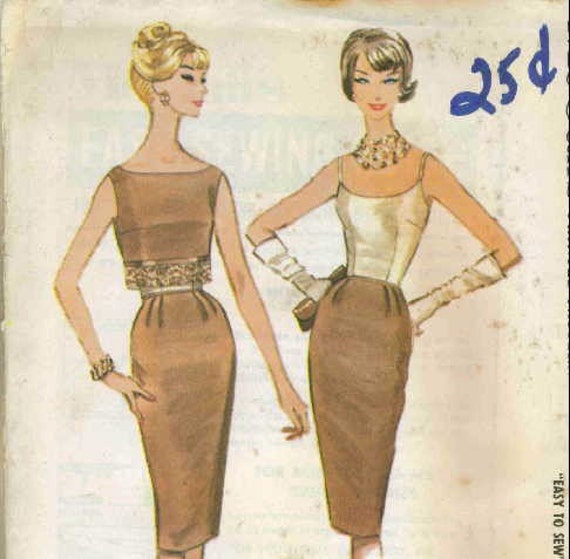
Cocktail dresses, “smarter than a day dress but not as formal as a dinner or evening dress” [21] were worn for early-evening parties. Short shrugs and bolero jackets, often made to match low-cut dresses, were worn.

Christian Dior’s ‘New Look’ collection in brought a revolution to the fashionable silhouette of the s. Dior’s nostalgic femininity of round shoulders, full skirts, padded hips and tiny waists replaced the boxy style of the wartime period at WWII.
The trend of hourglass silhouette brought by the popularity of Dior guaranteed the market for intimate apparel.
What is a 1950s sheath dress for women jumia
Although intimate apparels are usually hidden by outerwear, intimate apparel is especially emblematic for the contradictory beauty in the s as the silhouette was created depends on the type of foundation garments worn.
Foundation garments became essential items to maintain the curvy silhouette, especially waspies, girdles and horsehair padding.
For example, the sales of corsets doubled in the decade Haye, p. Symington Corset Company of Market Harborough was one of the famous intimate apparel producers in the s as they are the official producer of Dior’s corselettes and girdles.
The sugar-pink cotton velvet trimming was a particular feature of the range, and some were woven with Christian Dior’s initials in the elastic panels on the side This fabric was popular fabric to be applied on intimate apparel in the s because it was one of the first easy-to-launder and drip-dry fabric.
There was a full corset advertisement in shows the popularity of ‘Bri-Nylon’ and the design of the corselet in the s. The enchanting front panel is in Bri-Nylon lace and marquisette highlighted with criss-cross bands of narrow velvet ribbon.
Белые платья футляр Women’s s vintage – огромный выбор по лучшим ценам | eBay
It has side fastening – partly hook and eye with zipping extension. The very light boning is covered with velveteen. While the corselets reshaping the women’s body with tiny waists and big hips, a new shape of bra called ‘cathedral bra’ was introduced and became popular in the s.
It is called ‘cathedral bra’ because there would be pointed arches created by the bones over the breasts when the bra is worn.

The bones also separate and define the shape of the breasts by pressing them into a pointed or bullet shape. Therefore, ‘cathedral bra’ was also called the bullet bra.
Underwire bras were first introduced to the market in the s, however, it was forced to quit the market because the steel supply was restricted in the s for WWII.
Underwire brassiere design re-entered the market as it helped to uplift the shapes of the breasts to form the trendy curvy silhouette with big busts in the s.
Made with nylon, elastic nylon net and steel underwires, the underwire bras helped to create fashionable high, pert bosoms.
De Pietri, Stephen, and Melissa Leventon. Fashion in the s. What is a 1950s sheath dress for women A higher waistline gave the dress a longer look, when in fact most hemlines had only dropped about an inch.
Underwire bras are still dominating items in the modern intimate apparel industry. From the mids, a new unfitted style of clothing appeared as an alternative to the tight waist and full skirt associated with the New Look.
Vogue Magazine called the knitted chemise the “T-shirt dress.
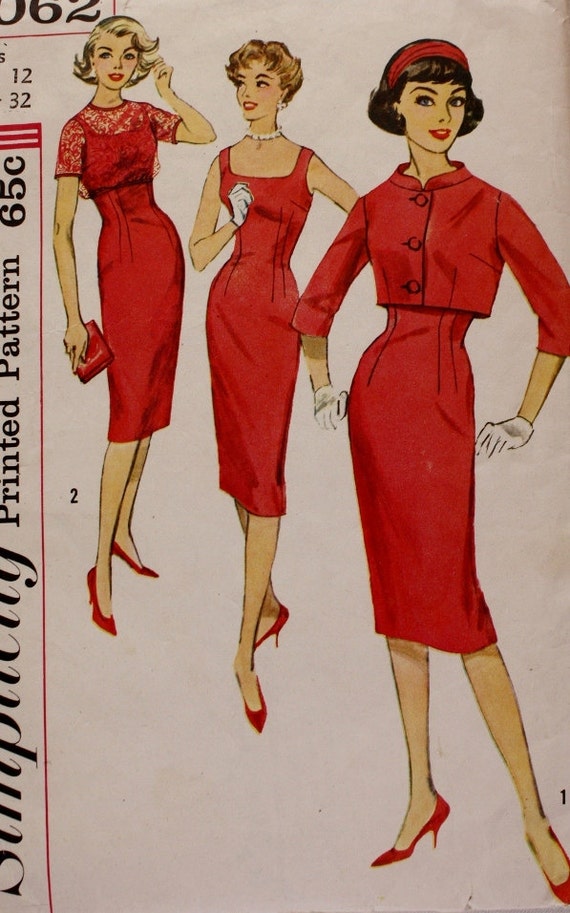
These dresses featured a shaped bodice with sloping shoulders and a high waist, but the signature shape resulted from a flaring bodice, creating a waistless line from bodice to knees.
Bymost suits featured lightly fitted jackets reaching just below the waist and shorter, narrower skirts. Balenciaga’s clothes featured few seams and plain necklines, and following his lead chemise dresses without waist seams, either straight and unfitted or in a princess style with a slight A-line, became popular.
The sleeveless, princess-line dress was called a skimmer.
01.03.2020 – Irish linen and silk were easily the two most desirable fabrics in Many women went a different direction altogether, piecing together their own postwar look with wide skirts and tailored suits. In India , the traditional Sherwani was adapted into the Nehru collar business suit , [5] while women frequently wore sarees in the workplace. Clouzot, Henri-Georges. Significantly, both of these styles were adopted or inspired by working-class men, rather than coming from the elite.
New York had become an American design center during the war, and remained so, especially for sportswear, in the post-war period.
Bytight fitting drainpipe jeans became popular among American women. In the s, pants became very narrow, and were worn ankle-length.
What is a 1950s sheath dress for women online the
Pants cropped to mid-calf were houseboy pants ; shorter pants, to below the knee, were called pedal-pushers. Shorts were very short in the early s, and mid-thigh length Bermuda shorts appeared around and remained fashionable through the remainder of the decade.
Loose printed or knit tops were fashionable with pants or shorts. They also wore bikinis to sport training. Swimsuitsincluding the Gottex brand popular in Israel and America, were one- or two-piece; some had loose bottoms like shorts with short skirts.
Sheath Dresses | New York & Company
Hair was worn short and curled with the New Look, and hats were essential for all but the most casual occasions.
Very short cropped hairstyles were fashionable in the early s.
By mid-decade hats were worn less frequently, especially as fuller hairstyles like the short, curly poodle cut and later bouffant and beehive became fashionable.
In the s, Lucille Ball was the first woman to show her pregnancy on TV. Most of the maternity dresses were two pieces with loose tops and narrow skirts.
Stretch panels accommodated for the woman’s growing figure. The baby boom of the s to the s also caused focus on maternity wear.
Even international designers such as Givenchy and Norman Hartnell created maternity wear clothing lines. Despite the new emphasis on maternity wear in the s maternity wear fashions were still being photographed on non-pregnant women for advertisements.
On September 29,the maternity panty [1] was patented which provided expansion in the vertical direction of the abdomen.

The front panel of this maternity undergarment was composed of a high degree of elasticity so in extreme stretched conditions, the woman could still feel comfortable.
Immediately after the war, men’s suits were broad-shouldered and often double-breasted. As wartime restrictions on fabric eased, trousers became fuller, and were usually styled with cuffs turn-ups.
In America, Esquire introduced the “Bold Look”, with wide shoulders, broad lapels, and an emphasis on bold, coordinated accessories.
Demobilised soldiers were provided with a suit by the government, usually in blue or grey chalkstripes. Savile Rowthe traditional home of bespoke or custom tailoringhad been heavily damaged in the Blitz and was slow to recover.
Savile Row introduced the “New Edwardian Look”, featuring a slightly flared jacket, natural shoulders, and an overall narrower cut, worn with a curly-brimmed bowler hat and a long slender overcoat with velvet collar and cuffs.

Dark charcoal gray was the usual color, and the era of the gray flannel suit was born. By the later s, a new Continental style of suit appeared from the fashion houses of Italy, with sharper shoulders, lighter fabrics, shorter, fitted jackets and narrower lapels.
Sport coats generally followed the lines of suit coats. Tartan plaids were fashionable in the early s, and later plaids and checks of all types were worn, as were corduroy jackets with leather buttons and car coats.
Bermuda shortsoften in madras plaidappeared in mid-decade and were worn with knee socks. Hawaiian shirtsworn untucked from suspenders, also became widely popular during this era.

This summer fashion of the Hawaiian or Carioca shirt became particularly popular in America, with even President Truman being photographed wearing a marine flora shirt.
Men’s hair fashion favoured the wet look, achieved by the use of products such as Brylcreem. Young men often grew their hair out and, with pomade or other hair treatments, coiffed their hair into pompadours.
 sheath cocktail dress with sleeves dresses near me